Showing posts with label book review. Show all posts

Sunday, May 8, 2016

The Dark Lady's Mask by Mary Sharratt a Review

THE DARK LADY's MASK
By
Mary Sharratt

SYNOPSIS:
THE DARK LADY’S MASK is the story of Aemilia Bassano Lanier (1569–1645), the first professional woman poet in Renaissance England, and her collaboration—and star-crossed love affair—with William Shakespeare, as his Dark Lady.
Shakespeare in Love meets Shakespeare’s Sister in this novel of England’s first professional woman poet and her collaboration and love affair with William Shakespeare
London, 1593. Aemilia Bassano Lanier is beautiful and accomplished, but her societal conformity ends there. She frequently cross-dresses to escape her loveless marriage and to gain freedoms only men enjoy, but a chance encounter with a ragged, little-known poet named Shakespeare changes everything.
Aemilia grabs at the chance to pursue her long-held dream of writing and the two outsiders strike up a literary bargain. They leave plague-ridden London for Italy, where they and begin to secretly writing comedies together and where Will falls in love with the beautiful country—and with Aemilia, his Dark Lady. Their Italian idyll, though, cannot last and their collaborative affair comes to a devastating end. Will gains fame and fortune for their plays back in London and years later he publishes the sonnets mocking his former muse. Not one to stand by in humiliation, Aemilia takes up her own pen in her defense and in defense of all women.

REVIEW:
I love reading the historical novels written by Mary Sharratt.  The depth of research and care she takes to develop her real life characters, to fill in the gaps and blanks that history has not recorded.  The line between hard fact and supposition becomes shades of gray as her stories grow and weave their way across time and through the pages.  Even the most jaded of historical scholars I have met, who have had the opportunity to read a novel or two written by Mary,  glow in praise about the stories she builds and the total believability of her tales. 
With this said, I come to this, Mary’s latest work, The Dark Lady's Mask.   As I was preparing to write the review for this interesting viewpoint on Shakespeare’s Muse, I chanced to have dinner with my parents.  While we were visiting my dad, an amateur genealogist who has spent the last thirty-six years researching our family tree, told me he had discovered the newest link in our family tree.  He had traced us to the court of Henry VIII of England.  He told me that the ancestor was Edward Bessano, an Italian musician who served in the court, along with his brothers and their families.  I took a deep breath and set back, for I had just finished The Dark Lady's Mask.  What a coincidence.  That evening and the following days since, this book has floated through my mind.  Knowing what I know now, I want and need to reread the pages again. 
I know the story is based on supposition.  I know that research has said that there were rumors and possibilities that Amelia Bassano Lanier could have been the dark lady.  But was she?  Taking the facts that I now have laying before me and meshing them with the story that Mary wove about Amelia Bassano Lanier and William Shakespeare, I find the connection totally plausible.  Her telling of Amelia’s story and life is wonderful.   
Once again Mary took a woman of note, who opened a door for generations to come, and allowed us to have a glimpse into her life.  Granted the hard facts on this gentle lady are few are far between, but Mary has a gift to take the pieces of a puzzle and lay them out, then masterfully paint in the missing areas.  Her work is so brilliantly accomplished, that we are left wondering where fact and supposition meet. 
Her interweaving of masterful character developments from a different viewpoint of the accepted norm for public historical figures such as William Shakespeare created cause for some raised eyebrows as the pages turned.  With fingers going to the keyboard looking for new information on the famed master of English literature.  I found even Snopes speaking out on the matter of Shakespeare’s Dark Lady.  That was interesting. 
The story itself was a well-told story.  It was one that held the attention and I found myself, once again, losing sleep because I couldn’t find a place to put the book down.  This was not because the plot was heart racing, but because the intrigue was different.  This was a story about women seeking to find a voice in a world dominated by men.  It was a place where they had no voice in where they lived or who they married.  Amelia was brilliant.  She had a brilliant mind.  But she could not follow her heart and write or publish her work that she wrote.  She was accomplished in music, writing, languages, math, and seemed to be able to learn most anything she attempted.  But she was allotted to the world and role of “woman” and the woman’s role. 
The idea that she utilized her creative genius to be able to get her work out there, even if it meant collaborating with a “second rate” playwright, was worth what it took to have her plays on the boards.  It was pure genius on Mary’s part on how she took the facts of what was happening during the time, historically, the facts that were available about Amelia’s life, and the suppositions that have been put out about the Dark Lady and weave them into such a glorious, believable story.  It is so believable, that I wonder how much is possible?  Maybe not the places, necessarily, but what happened, possibly.  It is all definitely meat on the bone to chew on.  It makes me look at Shakespeare with new eyes and wonder.
It makes me proud to have had such a wonderful and accomplished woman in my family tree.  Thank you, Mary, for writing about her and making her such a highlight in my life.  If you hadn’t written about Amelia Bassano Lanier, then when I dad told me about Elizabeth Bassano (Lupo) Chandler, born to Edward Bassano (a musician in King Henry’s court) and Alice Austen  (born 1596 East Greenwich, Kent, England); it would have just been another family tree fact.  No big deal.  You made it different.  You made it real.  Elizabeth Bassano Lupo migrated to Elizabeth City, Virginia Colony to accept a land grant from King Henry around 1619 from King Henry along with her husband Albiano Lupo.  He died and she later married John Chandler (first Jamestown, Virginia Colony) in 1626. 
I give this wonderful novel a full five stars for the indepth creativity of spirit and writing, and the masterful spin Mary Sharratt used to take the given and provide us with a most believable story of two master literary giants from our past.

QUESTIONS WITH MARY
Who was Aemilia Bassano Lanier? 
Born in 1569, Aemilia Bassano Lanier (also spelled Lanyer) was the highly cultured daughter of an Italian court musician—a man thought to have been a Marrano, a secret Jew living under the guise of a Christian convert.
After her father’s death, the young Aemilia Bassano was educated by high-minded Puritans. Later she became the mistress of Henry Carey, Lord Chamberlain to Queen Elizabeth. As Carey’s paramour, she enjoyed a few years of glory in the royal court—an idyll that came to an abrupt and inglorious end when she found herself pregnant with Carey’s child. She was then shunted off into an unhappy arranged marriage with Alfonso Lanier, a court musician and scheming adventurer who wasted her money. So began her long decline into obscurity and genteel poverty, yet she triumphed to become a ground-breaking woman of letters. 
Lanier was the first English woman to aspire to a career as a professional poet by actively seeking a circle of eminent female patrons to support her. She praises these women in the dedicatory verses to her epic poem, Salve Deus Rex Judaeorum, a vindication of the rights of women couched in religious verse and published in 1611. Her elegiac poem “The Description of Cookham” might be the first country house poem in the English language. Committed to women’s advancement and education, she served as tutor to the young Lady Anne Clifford, and she went on to found her own school for girls in 1617, a very progressive innovation in an era when girls were barred from most formal education.

What inspired you to write about this imagined star-crossed love affair between Lanier and Shakespeare?
My intention was to write a novel that married the playful comedy of Marc Norman and Tom Stoppard’s Shakespeare in Love to the unflinching feminism of Virginia Woolf’s meditations on Shakespeare’s sister in her essay A Room of One’s Own. How many more obstacles would an educated and gifted Renaissance woman poet face compared with her ambitious male counterpart? 
In The Dark Lady’s Mask, I explore what happens when a struggling young Shakespeare meets a struggling young woman poet of equal genius and passion. If Lanier and Shakespeare were, in fact, lovers, would this explain how Shakespeare made the leap from his history plays to his Italian comedies and romances—the turning point of his career? Lanier, after all, was an Anglo-Italian trapped in a miserable arranged marriage. The names Aemilia, Emilia, Emelia, and Bassanio all appear in Shakespeare’s plays. His Italian comedies are set in Veneto, Lanier’s ancestral homeland. What if Shakespeare’s early comedies were the fruit of an active collaboration between him and Lanier?
These two poets had such radically different character arcs. We all know about Shakespeare’s rise to the glory that would enshrine him as a cultural icon. But there was no meteoric rise for Lanier. Though she eventually triumphed to become a published poet, she died in obscurity and has only recently been rediscovered by scholars.
I find it fascinating how the strong, outspoken women of Shakespeare’s early Italian comedies, such as the crossdressing Rosalind in As You Like It and the spirited Beatrice in Much Ado About Nothing, gave way to much weaker heroines and misogynistic portraits of women in Shakespeare’s great tragedies, such as frail, mad Ophelia in Hamlet. This change in tack leads me to wonder if the historical Shakespeare actually did have a bittersweet affair with a mysterious, unknown woman that cast a shadow over his later life and work.
In this novel I wanted to redress the balance by writing Renaissance women poets and playwrights back into history. In addition to Lanier, the novel reveals the work of her contemporary poet-dramatists Mary Sidney and Isabella Andreini.

Enough about Shakespeare. Tell us about the relevance of Lanier’s poetry. Given her possible Jewish ancestry, why did she write Christian religious verse?
As an Englishwoman aspiring to make her career as a poet, Lanier effectively had only one option—to write devotional Protestant verse. Her literary predecessors, Anne Locke and Mary Sidney, wrote poetic meditations on the Psalms.
But Lanier’s religious poetry is a radical tour de force. Salve Deus Rex Judaeorum (Hail God, King of the Jews) describes the passion of Christ from the viewpoint of the women in the Gospels. Lanier recasts this grand narrative into a vindication of the rights of women—and of Lanier as a woman poet. In comparing the sufferings of women in male-dominated culture to the sufferings of Christ, she upholds virtuous women, such as her great patron Margaret Clifford, as Christ’s true imitators.
Most significantly, Salve Deus is dedicated and addressed exclusively to women, and is prefaced by nine praise poems dedicated to the royal and aristocratic women whose patronage Lanier sought. She also included a dedication in praise of all virtuous women.
Having established her female audience, Lanier attacks the theological roots of male domination, namely the blame attached to Eve—and by extension all women—for humanity’s fall from grace. In “Eve’s Apology in Defence of Women,” Lanier argues that the original sin was actually Adam’s for accepting the forbidden fruit. For he, unlike Eve, was fully aware of the consequences. Out of selfishness and desire for power, Adam let Eve take the fall.
                        If Eve did err, it was for knowledge sake,
                        The fruit being fair persuaded him to fall:
                                    No subtle serpent’s falsehood did betray him,
                                    If he would eat it, who had the power to stay him?
                        Not Eve, whose fault was only too much love.
Lanier contends that male culpability in crucifying Christ far exceeds Eve’s tragic   misunderstanding. Therefore there is no moral or divine cause to justify women’s subjugation. Here Lanier explicitly champions gender equality:
                                    Let us have our Liberty again,
                                    And challenge to yourselves no Sovereignty,
                                    You came not into the world without our pain,
                                    Make that a bar against your cruelty;
                                    Your fault being greater, why should you disdain
                                    Our being your equals, free from tyranny?
                                    If one weak woman simply did offend,
                                    This sin of yours hath no excuse, nor end.    
Lanier’s poetry lays claim to women’s God-given call to rise up against male arrogance, just as the strong women of the Old Testament rose up against their oppressors. While wooing her highborn female patrons, Lanier uses the scriptures to assert a sense of social egalitarianism that foreshadows the Levellers and the Quaker religious movement that emerged a few decades after her poetry’s publication. “God makes both even, the cottage with the throne,” Lanier writes in her dedicatory poem to Lady Anne Clifford, her former pupil.
Lanier’s book ends with “A Description of Cookham,” an elegiac ode to the country house where she lived for a time with Margaret and Anne Clifford, that blessed refuge where Lanier received both her spiritual epiphany and the confirmation of her vocation as a poet.
Farewell (sweet Cookham) where I first obtained
                                    Grace from the Grace where perfect Grace remained,
                                    And where the Muses gave their full consent,
                                    I should have the power the virtuous to content.
Salve Deus Rex Judaeorum is a corpus of poetry celebrating female and divine goodness, penned by a poet who found her own sense of salvation in a community of women who supported her and believed in her talent.

ABOUT THE AUTHOR
Mary Sharratt’s explorations into the hidden histories of Renaissance women compelled her to write her most recent work, THE DARK LADY’S MASK (Houghton Mifflin Harcourt 2016), based on the dramatic life of the ground-breaking poet, Aemilia Bassano Lanier.
Born in Minnesota, Mary now lives with her Belgian husband in the Pendle region of Lancashire, England, the setting for her acclaimed novel, DAUGHTERS OF THE WITCHING HILL, which recasts the Pendle Witches of 1612 in their historical context as cunning folk and healers.
Previously she lived for twelve years in Germany. This, along with her interest in sacred music and herbal medicine, inspired her to write her award-winning ILLUMINATIONS: A NOVEL OF HILDEGARD VON BINGEN, which explores the dramatic life of the 12th century Benedictine abbess, composer, polymath, and powerfrau.
Winner of the 2013 Nautilus Gold Award, the 2005 WILLA Literary Award, and a Minnesota Book Award Finalist, Mary has also written the novels SUMMIT AVENUETHE REAL MINERVATHE VANISHING POINT, and co-edited the subversive fiction anthology BITCH LIT, which celebrates female anti-heroes–strong women who break all the rules. Her short fiction has been published in Twin Cities Noir and elsewhere.
She is currently at work on ECSTASY: A NOVEL OF ALMA MAHLER, exploring the life of one of the most intriguing women of turn-of-the-century Vienna.
Mary’s articles and essays have appeared in The Wall Street JournalThe Huffington PostPublisher’s WeeklyMinnesota Magazine, andHistorical Novels Review. When she isn’t writing, she’s usually riding her spirited Welsh mare through the Lancashire countryside.

PURCHASE


Tuesday, April 5, 2016

The Winemakers - Jan Moran

The Winemakers
By
Jan Moran

SYNOPSIS
1956: When Caterina Rosetta inherits a cottage in the countryside of Italy from a grandmother she’s never known, she discovers a long-buried family secret — a secret so devastating, it threatens the future of everything her mother has worked for. Many years before, her mother’s hard-won dreams of staking her family’s claim in the vineyards of California came to fruition; but as an old murder comes to light, and Caterina uncovers a tragic secret that may destroy the man she loves, she realizes her happiness will depend on revealing the truth of her mother’s buried past. The Winemakersis a sweeping, romantic novel that will hold you in its grasp until the last delicious sip.
“Absolutely adored THE WINEMAKERS.  Beautifully layered and utterly compelling.  Intriguing from start to finish.  A story not to be missed.” – Jane Porter, USA Today and NYT Bestselling author of It’s Youand The Good Woman

REVIEW:

I have read all of Jan Moran’s novels, to date. Each one of them are centered on strong women of their time. Each set in various time periods dating back to the early 1900s. What is interesting is that even the two major works she has written “Scent of Triumph” and “The Winemakers” have an essence of being tied into “The California Series” which about four young independent young women is making their way in the L.A. area and making their mark on the beauty industry.
In the Winemakers all of the strengths and fallibilities that we as women have, come into play and you find yourself in a world of secrets within secrets, as each of the central characters keeps her world wrapped up within pride to protect those she love around her. But as the leaves of truth start to peel back, the world they have always known starts to crumble around them into a thousand pieces like a dried out bouquet of flowers when crushed under foot. It is only the strong love of family and pride of who they really are that allows them to struggle through, to find the answers at the heart of the lies and secrets that the years have held close.
Jan has a way of drawing the reader into her stories. She takes a paint brush to her words and brushes a panorama across the pages. You find yourself falling into the scenes of the lands and places that she builds for her stories to take place. The smells, sights and sounds accost your senses as you find yourself peering through the eyes of the characters and seeing a world unfold before you.
This is not limited to just her scenery, but also to the very fiber of her story lines. They live and breathe as you find yourself flipping the pages to keep up with the characters, wiping tears of sadness or laughter. Suddenly a page turn will bring a catch of breath that forces you to set down the book till you can breathe again…forcing you to think back, re-access and draw on your own strength to go forward with the young heroine.
Once again Jan has given us a glimpse behind the shutters of the wealthy and high born to show us that all who live have lives that can be fragile. All who breathe can suffer great loss and hold great secrets that seem unbearable. Wealth and breeding do not make people immune to the bad things that can and do happen to families. Evil is evil, no matter the last name. Kindness, generosity, and love come from within and cannot have a price tag attached.
Jan has also shown the struggles that independent strong minded women have endured during the early part of the 1900s. She included the prejudices against women in business within her storyline. I deeply appreciated this. We forget how much our mothers and grandmothers fought to make our lives better for us. How we must continue to strive to make the way better for our daughters and grand-daughters who follow behind.
Jan Moran has written stirring and remarkable works from her first novel, Flawless, but with each offering, she has shown continued growth in her craft. The Winemakers is a novel worthy of note and one that is sure to make many lists and take awards for 2016. I give The Winemakers a FIVE STAR rating for craftsmanship and entertainment. This is a must read for 2016.
ABOUT THE AUTHOR
Jan Moran is an author of historical novels for St. Martin’s Press (Scent of Triumph,; The Winemakers). She also writes the Love, California contemporary series, which includes FlawlessBeauty Mark,Runway, and other upcoming titles. She wrote Fabulous Fragrances I and II, which earned spots on the Rizzoli Bookstore bestseller list, and Vintage Perfumes. She is represented by Jenny Bent at The Bent Agency. Books are also translated into German, Portuguese, Turkish, Italian, and other languages.
As a fragrance and beauty expert, she has been featured in numerous publications and on television and radio, including CNN, Women’s Wear Daily, Allure, InStyle, and O Magazine. As an editor and writer, she has covered fragrance, beauty, and spa travel for a variety of publications such as CosmopolitanCostco Connection, and Porthole Cruise.
VISIT JAN
http://www.janmoranwrites.com/

WHERE YOU CAN BUY


Sunday, March 13, 2016

A Desperate Fortune by Susanna Kearsley - A Book Review

A DESPERATE FORTUNE
By
Susanna Kearsley

SYLLABUS:
For nearly 300 years, the mysterious journal of Jacobite exile Mary Dundas has lain unread — its secrets safe from prying eyes. Now, amateur codebreaker Sara Thomas has been hired by a once-famous historian to crack the journal's cipher. But when she arrives in Paris, Sara finds herself besieged by complications from all sides: the journal's reclusive owner, her charming Parisian neighbor, and Mary, whose journal doesn't hold the secrets Sara expects.

It turns out that Mary Dundas wasn’t keeping a record of everyday life, but a first-hand account of her part in a dangerous intrigue. In the first wintry months of 1732, with a scandal gaining steam in London, driving many into bankruptcy and ruin, the man accused of being at its center is concealed among the Jacobites in Paris, with Mary posing as his sister to aid his disguise.

When their location is betrayed, they’re forced to put a desperate plan in action, heading south along the road to Rome, protected by the enigmatic Highlander Hugh MacPherson.

As Mary's tale grows more and more dire, Sara, too, must carefully choose which turning to take... to find the road that will lead her safely home


REVIEW
I love when I come across a novelist who is capable of giving the reader a book that makes them think, that makes them interact with the characters of the book and become involved with the multiple storylines they weave through the pages and chapters of their work. 
A Desperate Fortune did just that.  This work gave the reader a very delicate social and medical plot for the protagonist in the current age that she had to deal with.  Susanna enabled us to live with Aspergers and see the world through the eyes of Sarah.  She did a fantastic job of it.  At the same time, she wove a very gentle love interest plot through as a subplot, but it wasn’t just a romantic love interest, it was about learning to love.  It was beautiful and I found myself also falling in love with both gentlemen of the house, very deeply in love.
The second major plot and storyline took us to another time and place 300 years earlier.  This story and the ebb and flow of the characters were of a totally different feel.  It was almost as if it was two different books.  But this was not a bad thing.  The characters were totally different.  The times and the demands of what was happening within the diary that Sarah was translating dictated what the second storyline followed. 
I loved that Susanna did not leave us, the readers to the strict diary renderings as to what we discovered about what happened 300 years prior, but allowed us to see the world through the eyes of the young lady, Mary, who wrote the diary.  In doing so, we were able to better glimpse the strife and restrictions that living in the court of King James court in France and Rome. 
The time that Susanna took to develop the central characters in both settings brought the stories alive.  From the poignancy of the life of Sarah in modern France as she grew more self-assured and slowly fell in love to the wild and scary times of the 1700s in France, Spain, and Italy as Mary, the 1700’s protagonist discovered her strengths and self-reliance those many years ago in another place and time. 
With each turn of the page, I found myself wanting more and more from the characters and the story itself.  Susanna stepped up to the plate and delivered.  Each time she stepped from one time period to the other, I found myself devastated, I was so immersed into the story and characters of the period I was living and breathing.  I did not want to leave.  It was the same with the next time swap, I did not want to go back.  But as soon as the story picked up, I knew new information would come up, and it did that pulled me right into the timeline of the new time period I was in, along with the storyline that was swirling around the characters that were moving swiftly through the pages. 
This is not my first Susanna Kearsley book, nor will it be my last.  Each of her novels are unique and touch heart strings at their deepest levels.  This novel has earned my highest praises and will be one that I pull out to read and enjoy again.  I would give A Desparate Fortune a Five Star review for the telling of the story and for the story craft in the telling.

ABOUT THE AUTHOR
Susanna Kearsley Aka Emma Cole.

Susanna Kearsley studied politics and international development at university, and has worked as a museum curator.

Her first novel Mariana won the prestigious Catherine Cookson Literary Prize and launched her writing career. Susanna continued her mix of the historical and paranormal in novels The Splendour Falls, Named of the Dragon, Shadowy Horses and Season of Storms.

Susanna Kearsley also writes classic-style thrillers under the name of 
Emma Cole.
Contact the author at http://www.susannakearsley.com/ 
Where to buy A Desparate Fortune


Monday, November 9, 2015

Papoose hi resAny native West Virginian knows every word of John Denver’s legendary hit and can sing the lyrics from the time they can follow the tune and form the words (or near sounds).  “Take me home, country roads, to the place I belong.  West Virginia, mountain mama, take me home, country roads.” Driving down the back lanes of the winding mountain roads you can almost hear the strains of the banjos and guitars blowing with the wind through your hair as it whistles through open windows of your vehicle. 
There is a sense of having arrived and wanting to belong, a sense of finding home every time you visit, or come back home.  I should know, I lived in one of the most remote areas of the state, not too far from the settings of these three novels, for almost five years.  Just like the scenes and places in the great Louis L’Amour’s novels, even though the names of the locales and business were fictionalized, I have walked the streets of similar towns in the area and am well acquainted with the personalities of many of the small locales.  Nancy nailed the spirit of the small, isolated town in rural West Virginia.  She was able to verbalize the spirit and genuineness of the people.  In these three novels Nancy singlehandedly dispelled the longstanding aura of “dueling banjos” that has so haunted the area and villainized the souls of people who lived there.  No wonder outsiders who wander through or seek a place of solace, find themselves putting down roots and settling in this little piece of heaven on earth.
 The central focus the three novels revolved around was a horse stable run by a former Olympic medalist.  The name of the stable was Healing Springs Stable.   Sharon, the owner of the stable, took in horses nobody wanted anymore or were old or ill.  She also believed that every person had a Whisper Horse.  Whisper Horse?  No, not a horse whisperer, but a whisper horse.  “A horse you can tell all your troubles to.”  Horse owners have a special connection with their animals.  Horses will run themselves to the ground for their owners, they respond to body language, to voice nuances.  They are highly intelligent.  Sharon’s idea of a whisper horse is not a bad idea.  Horses need to be needed as much as humans need someone.   Nancy recently quoted on her FB page about the friendship between man and his horse.
"When your horse follows you without being asked, when he rubs his head on yours, and when you look at him and feel a tingle down your spine...you know you are loved." --John Lyons
This energy and joy was evident throughout her novels.  Until you have known the joy of a horse’s love, you have not known the joy of unconditional love.
The stories, though each is a stand-alone, grow and build upon the one before it.  The characters have active full lives that are not narrow in scope.  They care about each other, their neighbors, and their community.  They are close knit, and beware he/she who threatens one within their community.  In fact, “community” is very much a sub-plot through the entire series.  Community is very much a way of life in the mountains of West Virginia.

Nancy Herkness has been recognized for her literary skills and abilities.  In 2014 Country Roads received the nomination for the coveted RITA award for Contemporary Romance Novel.  Then in 2015 The Place I Belong also received a RITA nomination.  It is a privilege and honor to be able to  takemehome_150
TAKE ME HOME, COUNTRY ROADS, THE PLACE I BELONG         
SYNOPSIS – When Claire Parker left Sanctuary, West Virginia, she thought it was for good. But now she’s back, reeling from an ugly divorce. Readjusting to small-town life is harder than Claire expected, so she’s surprised, and grateful, to find companionship in Willow, an abused Thoroughbred mare. Willow is Claire’s “whisper horse,” and they share a special, rare bond. Except Willow isn’t the only one helping Claire heal; Willow’s ruggedly handsome veterinarian, Dr. Tim Arbuckle, is sympathetic…and secretive. Devastated by his wife’s death, Tim thought he’d never find love again. The stoic, sexy doctor was sure he’d left his heart behind when he came to Sanctuary. But Claire stirs up emotions he thought he’d buried long ago. For the first time, the doctor tries to see past his grief. When Willow falls gravely ill, Tim and Claire must work together to save the horse’s life and to find a love so encompassing, so intense, their lives will never be the same again 
Review-  Nancy Herkness assaulted the senses with each turn of the page in the first of the Whisper Horse novels, Take Me Home.  I found myself sucking in deep breaths on more than one occasion as I felt Claire’s pain of desolation in the aftermath of her divorce.  She had been ground down and her spirit powdered to the point of becoming but dust-in-the-wind.  
Self confidence in her work, as a professional, and self-worth in who she was as a person was at nil.  There was little evidence left of who she formerly was. The story of a deep love and attachment between a woman in deep sorrow and a horse who reached back spoke to this reader’s heart.  
When the human love interest was introduced in the form of a huge crotchety bear of a man, who also happened to be the local country vet, it was like adding all your favorite spicy flavorings to the pot from the kitchen cabinet and giving the pot a good stir. The interactions between Clair and Doc Tim ignited in sparks and fire from the beginning.  
As we all know, where there are sparks and smoke, there is fire.  Fire did take hold and the pages and chapters burned with the flames of their burning passions as Claire and Tim worked through the issues that prevented them from fanning those embers and ultimately setting the sheets on fire. 
Pages could not turn fast enough as I followed this fast paced love affair and affair of the heart through to the end.  I was so thankful that book two of the series was sitting on the table waiting for me to pick up the next evening. Consistently, Nancy’s love stories leave me short of breath and longing for more.  
This story did not disappoint.  I gave this book a solid FIVE STAR review. 
Amazon | Kindle | Barnes & Noble 
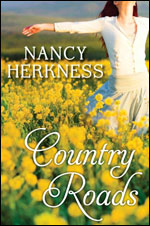
countryroads_150COUNTRY ROADS (2014 RITA AWARD NOMINEE)   SYNOPSIS – When sheltered artist Julia Castillo flees her hometown, she has one goal: to prove to her overbearing family she can make it on her own. She knows they only want the best for her, but when they question her artistic vision, it’s time to break free. 
Julia’s search for independence carries her to the small town of Sanctuary, West Virginia. There, her courage is tested as never before—by her love for a handsome country lawyer, her bond with a dangerous black stallion, and a secret she is desperate to keep… Paul Taggart abandoned his high-powered legal career to return to Sanctuary, giving up his own dreams to care for his troubled brother. Then Julia Castillo blows into town like a fresh mountain breeze, changing his staid, predictable life forever. 
Has Paul earned his second chance at happiness? Or does loving Julia mean having the strength to let her go? Review- Only someone who has had to run for their life, someone who has had to truly look over their shoulder in fear, could have expressed the fear and desperation that the young girl (Julia) was experiencing when she first arrived in Sanctuary, West Virginia.  
Nancy Herkness captured the essence of what it would be like to be suddenly on your own and alone.  But what was she really running from or was it something she was striving to run to?  The “White Knight” that comes to her rescue not only is the protector of her legal matters, but becomes the “Knight” who takes on the conquest of her heart. 
Once again Nancy pairs our heroine, Julia, up with an injured horse at the riding stable run by the former Olympic star, Sharon.  This time the stallion is one that has been abused and strikes out at any and all who reach out to him – until he meets the red-headed Julia.  An immediate spark between the two leaves the entire staff at the stables puzzled and awed as the two become inseparable. 
Nancy opened up in this telling of her story.  The depth of the development of each of her characters, from the young artistic Julia and her love of painting horses to the gallant Paul who was the “white knight” and lawyer who fell head-over-heels in love with Julia from the moment he laid eyes on her.  
The characters lived and breathed as they walked between the pages.  The back stories on some of the intricate details and focus points of the story gave it depth and weight that you would expect to “know” about everybody and everything in a small mountain town in the back woods of West Virginia. 
There were times I felt like I was walking along with the characters through the lanes and down the streets of Sanctuary.  I could feel the rip of the wind through my hair as we raced down country roads and felt my stomach flip and roll with the sharp corners.  I even felt the sting of the gravel on the country roads when riding the bike.  Oh and the smell of the pine and moldering leaves high in the mountains where there was no pollution and only the smells of nature to catch your attention as you set on that cool damp moss by the river.  
Yes, I lived and loved every word of this wonderful novel.  It is no wonder that it was nominated for the 2014 RITA Award!! A definite FIVE STAR review of my favorite novel by Nancy Herkness, to date!!!!
  Amazon | Kindle | Barnes & Noble
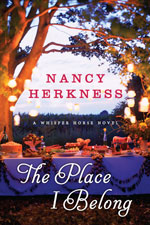
placeibelong_150THE PLACE I BELONG (2015 RITA AWARD NOMINEE)   SYNOPSIS – Fleeing professional scandal and a broken engagement, veterinarian Hannah Linden abandons Chicago for the mountain town of Sanctuary, West Virginia, hoping to put her troubles with men and the media behind her. But when she encounters world-famous chef Adam Bosch, she finds herself increasingly drawn to the charming but darkly complex man and his troubled teenage son, Matt.  
Adam, a recovering alcoholic, fears he can never be a worthy father to the surly, distant boy he has just come to know, and enlists Hannah’s help in his struggle to connect with his son. Hoping to coax Matt out of his shell, Hannah introduces the boy to an ailing brown pony who has the power to change his view of the world. But can the determined little whisper horse prove to Hannah, Adam, and Matt that they were meant to be a family? Review- As Nancy has continued with the Whisper Horse Series, her writing perceptions and story-telling skills have been honed and each story has shown her growth as a writer.  
The Place I Belong, is the crowning jewel of her, work, to-date.  The complexity of the storylines, taking three separate stories and over-laying each one with the other, weaving them together like a work of art has created a masterpiece of the written word.  To add color and additional depth to this already intricate story, Nancy reached back into each of the two previous Whisper Horse books and utilized the back stories of the characters from those novels to broaden and fill-out the beauty of The Place I Belong.  
Weaving these characters and their continuing stories into the current novel brought additional life to the pages.  Suddenly, these were real, living people who interacted on a daily basis and lived as a community.  The feeling of community seems to come out the loudest and most keenly in this, the final novel. 
Like Country Roads, I think that The Place I Belong is some of Nancy Herkness’ best writing to-date.  This set showcases her storytelling gift at its best.  I loved this book because it was about finding family.  It was about community.  
Oh yes, there were her wonderful pages where she showed her great skills at storytelling and description and leaves us all swooning, but to me, the story, not to be missed is about the priority of finding family and the priority of family in your life.  
This, her third novel in the series, gets a standing ovation and FIVE STARS in my review of her novel The Place I Belong. 
Amazon | Kindle | Barnes & Noble
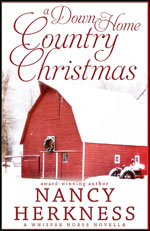
countrychristmas_150 A Down Home Country Christmas   Synopsis - After escaping an abusive marriage, Holly builds a haven of security for herself and her two young daughters.  She’s helped along by police captain Robbie McGraw, who stood by her through the worst. 

Now he shows a different kind of interest, one that thrills Holly, even as she questions the wisdom of trusting another man so soon. But Robbie is on the brink of fulfilling a dream—one that will send him out of the mountain town of Sanctuary, West Virginia, and away from the allure of Holly’s warm spirit and tempting body. A wily little Christmas donkey and the magic of the holidays prove to Holly and Robbie that the courage to love can make dreams come true. 
Kindle
nancy herknessABOUT NANCY HERKNESS – Nancy Herkness is the author of the award-winning Whisper Horse series, published by Montlake Romance, as well as several other contemporary romance novels. She is a two-time nominee for the Romance Writers of America RITA® award. 
Her new series, Wager of Hearts, follows the romantic adventures of three very wealthy men who make a life-changing bet. 
A member of Romance Writers of America, New Jersey Romance Writers, and Novelists, Inc., Nancy has received many honors for her work, including the Golden Leaf Award, the Maggie Award in Contemporary Romance, and the National Excellence in Romance Fiction Award. 
Nancy graduated from Princeton University where she majored in English. In addition to her academic work in literature, she was accepted into Princeton's creative writing program, and her senior thesis was a volume of original poetry. 
After graduating, Nancy had a varied career which included retail management and buying, COBOL programming, computer systems sales and marketing, and a brief stint as a receptionist at a dental office. Once her children were in school full-time, she sat down and wrote A Bridge to Love, her first romance novel to be published. 
Nancy finds nothing odd about writing in the genre she calls “the “Rodney Dangerfield of the literary world. It gets no respect.” She explains: “I was trained as a poet, but from the day my grandmother gave me my first Georgette Heyer novel I wanted to write romance. Romance is the genre of optimism, and that's why I like it.” 
A native of West Virginia, Nancy now lives in suburban New Jersey with her husband, two mismatched dogs, and an elderly cat. She cheers loudly for the New Jersey Devils hockey team.  
Papoose hi resA VISIT WITH NANCY – Karen: Where did the idea for a “whisper horse” come from?  Did you share all your troubles with your horse(s) when you were 
Nancy: The idea of a “whisper horse” came from my real pony Papoose (pictured above) who was my constant companion all through my younger years.  When I was upset or angsty, I would pour my problems into his ears.  If you know horses, you’ll know their ears are very eloquent, so I felt I had a sympathetic listener.  Not to mention that he would never share my secrets with anyone else. Horses are very discreet. 
Karen: Growing up in a location that has a love affair with the art scene is a gift for any child.  How did this affect you?  Did you ever dabble in art?  If so, what medium do you like to create in? 
Nancy: My little hometown had an amazing number of artists when I was young and has even more now.  Our school had an art contest every year, and I often won a ribbon with my crayon drawings. 
I think that started my interest in art. There was a local sculptor who offered lessons in clay sculpting which my parents enrolled me in. I still remember the horsehead I created; I was quite proud of it. 
I doodled pencil sketches of horses on all my class notes in school. The one medium I never could get comfortable with was stone; I was terrified that one chisel stroke would ruin the whole piece, so I was a very timid stonecutter. 
All of this made me a very visual writer: I see the scenes in my mind and then try to capture them as vividly as possible in words. 
Karen: Do you still get to ride often?  What breed of horse is your preference to ride?  What style of riding to you prefer to ride? 
Nancy: Living fifteen miles west of New York City is not conducive to my preferred kind of horseback riding. After galloping all over the hills, trails, and woods of West Virginia, trotting around a ring is just too tame for me. Whenever I’m on vacation, I try to find a great trail ride to go on. I grew up riding hunters and jumpers so I am most comfortable on an English saddle. Since my riding muscles have grown flabby from lack of use, I no longer ride over fences, but I sure miss the sensation of flying through the air! 
Karen: Knowing the inspiration that you grew up with from living in around that area of West Virginia, how do you decide on what to write next?  Will we see another Whisper Horse installment?  Maybe one for Sharon and her story? 
Nancy: Much as I loved returning to my roots in the mountains, there will not be any more Whisper Horse stories for now. While these books found many enthusiastic readers, there weren’t quite enough sales for my publisher to continue the series. So I had to bid farewell to my beloved Appalachian mountains and return to my current locale near the skyscrapers of Manhattan. I’ve now lived here longer than I lived in West Virginia, and my children are native New Jerseyans, so I’m quite comfortable setting stories in the NY metro area. 
I hope my readers will follow me into the Wager of Hearts series, in which three very wealthy men make a life-changing bet on finding love in the steel canyons of New York City. 
While the setting is different, the characters still wrestle with the timeless issues of family and obligation, as well as true love. The first book, The CEO Buys In, was released in July 2015. The next novel is The All-Star Antes Up, scheduled for May 2016. 
Karen: Congratulations on your nominations for the 2014 and 2015 RITA awards for Contemporary Romance novels.  It speaks to the quality of your writing, the spellbinding stories you have to tell, and the connection you make with your readers’ hearts. 
Nancy: Thank you so much! I’ve been hugely delighted and flattered by the honors my Whisper Horse novels have won. You could have knocked me over with a feather when I got those RITA nomination calls. I sure wasn’t expecting my quirky West Virginia characters to soar so high. 
Karen: For fun…. Can you tell us one thing about yourself from growing up in WV that we don’t know?   Nancy: There is one secret about me that harks back to my youth in West Virginia: I am a Lady of the Golden Horseshoe.  When I was in eighth grade, I was knighted with an antique sword by the state’s governor for getting my county’s top test score in West Virginia history. Unfortunately, I didn’t get a tiara. Thank you so much for having me a guest on your wonderful blog! It was a pleasure to chat with you. 
Karen:  Nancy, it is always a joy to visit with you and I love delving into your books.  Thank you for taking the time to share with us and letting us see into why the Whisper Horse series is so special to you. You can purchase your own copies at major bookstores and at online retailers.  

Thursday, August 13, 2015

The Way of Sorrows - Jon Steele - A Book Review


The Way of Sorrows
By
Jon Steele

SYNOPSIS
The earthly—and cosmic—adventures of Katherine Taylor and Jay Harper come to an electrifying, action-packed conclusion in The Way of Sorrows, the final installment of Jon Steele’s critically acclaimed Angelus Trilogy.

After the heart-stopping cliff-hanger that concluded Angel City, Katherine Taylor and Jay Harper return in this ultimate portrayal of good versus evil—Apocalypse-style. Will the remnants of the Nephilim—fallen angels from time immemorial—capture and destroy baby Max, Katherine’s half-mortal/half-heavenly child? Or will otherworldly Special Agent Harper be able to thwart these hideous plans and prevent the end of mankind? Spanning the globe—and the heavens—Jon Steele’s brilliant, rich, and imaginative book is a masterpiece of science, religion, and fantasy.

REVIEW
The Way of Sorrows was a unique read that required the full attention of this reader.  Maybe I wouldn't have been so distracted if I wasn't a student of prehistory of ancient Biblical history, but my brain kept working in overtime as I processed the complex story up against my own internal database of "ancients" knowledge.  I absolutely loved the added twist of the time dimensions and the way he inferred their beginnings.  What I am now dying to do is to go back and read books one and two.
I feel that Jon Steele has come the closest to verbalizing some of my personal concepts of pre-history and the war between good and evil than anyone else I have read and to do it in this fantastic sci-fi setting is totally awesome.  The Way of Sorrows is a classic example of a mash up of genre.  Even though it is definitely listed as Sci-fi, I would also not hesitate to place the book in historical fiction, or is it possible to create a new genre, Historical Sci-Fi Fiction?  I have actually read several books in the last few years that I could place in this category.  For students well versed in a certain historical period, i.e. ancient pre-history, they would identify the mash up quickly and easily.  They would see the parallels and draw history out of the Sci-fi setting.   Knowing this history, broadens the enjoyment and fills in and answers potential questions that might otherwise left me puzzled.
To say Jon’s characters were complex and deeply developed would be an understatement.  Each of the characters lived in multiple times and in multiple dimensions, with their earth and “other worldly” names.  Not having read books one and two yet (my bad, and soon to be remedied) this was at first confusing, but I caught up and was soon deeply immersed into the story.
His over-lay of the God family and the kidnapping was fantastic.  His understanding and being able to lay-out so clearly the concepts of inter-dimensional time and the layers and layers of time, as well as the creative way he had for moving between them was fabulous.  The conclusion was fabulous and gave you a sense of hope for tomorrow.    
Jon would be wonderful to sit down and visit with sometime.  His book is well worth the read for any true futuristic sci-fi addict, as well as anyone willing to take on a mental rollercoaster challenge.  I give this a full FIVE STAR for thrills and great reading.

ABOUT THE AUTHOR
JON STEELE is an award-winning journalist and author of The Watchers and Angel City. Born in Spokane, Washington, he traveled the world, working as a cameraman for Independent Television News. After a twenty-year career, Steele wrote the critically acclaimed War Junkie. In 2008, he co-wrote, codirected, and shot Baker Boys: Inside the Surge, a documentary about an American combat unit in Iraq. He lives in Switzerland.

·        File Size: 4376 KB
·        Print Length: 512 pages
·        Publisher: Blue Rider Press (August 4, 2015)
·        Publication Date: August 4, 2015
·        Sold by: Penguin Group (USA) LLC


Wednesday, July 22, 2015

The Martian - Andy Weir


SYNOPSIS
Six days ago, astronaut Mark Watney became one of the first people to walk on Mars.
Now, he's sure he'll be the first person to die there.
After a dust storm nearly kills him and forces his crew to evacuate while thinking him dead, Mark finds himself stranded and completely alone with no way to even signal Earth that he’s alive—and even if he could get word out, his supplies would be gone long before a rescue could arrive.
Chances are, though, he won't have time to starve to death. The damaged machinery, unforgiving environment, or plain-old "human error" are much more likely to kill him first.
But Mark isn't ready to give up yet. Drawing on his ingenuity, his engineering skills—and a relentless, dogged refusal to quit—he steadfastly confronts one seemingly insurmountable obstacle after the next. Will his resourcefulness be enough to overcome the impossible odds against him?

REVIEW
Space, the final frontier.  I have been a die-hard fan of flying to the stars for as long as I can remember.  My dad took me down to the Capital in Santa Fe, when I was five, so I could see the space capsule and shake the hand of the astronaut who flew into space (around the world a couple of times).  He gave me a signed postcard and a little flag.  My dad still has them and I still have the vivid memories. 
I still have the vivid memories of my dad waking us up so we could witness Neil Armstrong landing on the moon and taking those first steps.  “One small step for man, one giant leap for mankind”.  It was an old black and white TV and the reception wasn’t the best, but we were watching history for mankind, and I felt the import of the event.
Sending men to Mars is not too much farther in my mind for us to do.  Come on, how far have we gone with Star Trek? Star Wars?  But really, even now, we have managed to get a space vehicle to go to Pluto with only a four hour delay in transmission.  WOW!!!!  That is so far beyond my thinking of the speed of what I thought we were capable of.
And then we land a man on Mars and he gets taken out by a sandstorm, not a meteor shower, or a capsule blowing up, but a sandstorm… man, we had sandstorms in Texas that could take out houses…
Can you imagine?  Stuck on Mars?  And no ride home?  At least not for three or four years.  Boy, time for creative thinking.  I have a year’s worth of food and no water…hm.  Well, of all the guys to get stranded, the lucky dog would be the farmer.  And to make matters even better, he was also the tinker man. 
I grew up with the expression being bounced around “nothing that bailing wire and duct tape won’t fix.”  Between a botanical degree, and the ability to disregard box-style thinking, Mark managed to create a biosphere from Martian soil, his waste, and figuring out how to suck water out of some Hydrogen fuel tanks.  He also created enough food to survive utilizing a few fresh food items he discovered on-board and growing them in the created biosphere. 
What kept the book, Mark, and me rolling, was the rollicking, tongue in cheek journal entries that were a caustic slap schtick.  He had the ability to laugh at his perilous situation and mock his tenuous hold on life out in the wilds of Mars --- alone.
In its interesting way, the book truly gave us a look at the kind of personality and tenacity that it demanded of an person who commits to a long term program of isolation and stress.  The demands needed to think on his feet, to be flexible, to be creative, to work through, around, over, and rework problems and solutions till answers are found. 
The other storylines of how NASA back on earth, and the astronauts returning home in the spaceship were handing the incident were also quite interesting.  While Mark was focused on survival, survival, survival, back at NASA politics and petty hierarchies seemed to take preferences, at times to the actual goal of getting Mark back home. 
The book was written in a journal format and in the first person.  The sections where there were flash-overs to NASA and to the other space craft (rocketing back towards earth), was written in a third person voice, as you observed what was happening, much like a fly on the wall.
Back story and depth was skillfully played out through Mark’s reflections in his log.  At one point, once he realized that NASA knew he was alive, he made the sarcastic remark that he was going to have to go back and clean-up and delete some entries on the journal, now that he knew it would be read.  I cracked-up.  Ooops….
I have always been one who says give me the book, maybe I’ll watch the movie, but this time around, Andy did such a wonderful job of building the world that Mark had to survive in, that I am now dying to see how it is visualized on the big screen this fall when the movie comes out. 
I loved this book.  It was a wonderful lite read that left me laughing.  The technical jargon was part and parcel and made the book work.  I give this book a full FOUR STAR RATING.  A great weekend read.  And a must read before you see the movie!!!!!
Net Galley provided a copy for me to read and review.

ABOUT THE AUTHOR

ANDY WEIR was first hired as a programmer for a national laboratory at age fifteen and has been working as a software engineer ever since. He is also a lifelong space nerd and a devoted hobbyist of subjects like relativistic physics, orbital mechanics, and the history of manned spaceflight. The Martianis his first novel.