Sunday, May 8, 2016

The Dark Lady's Mask by Mary Sharratt a Review

THE DARK LADY's MASK
By
Mary Sharratt

SYNOPSIS:
THE DARK LADY’S MASK is the story of Aemilia Bassano Lanier (1569–1645), the first professional woman poet in Renaissance England, and her collaboration—and star-crossed love affair—with William Shakespeare, as his Dark Lady.
Shakespeare in Love meets Shakespeare’s Sister in this novel of England’s first professional woman poet and her collaboration and love affair with William Shakespeare
London, 1593. Aemilia Bassano Lanier is beautiful and accomplished, but her societal conformity ends there. She frequently cross-dresses to escape her loveless marriage and to gain freedoms only men enjoy, but a chance encounter with a ragged, little-known poet named Shakespeare changes everything.
Aemilia grabs at the chance to pursue her long-held dream of writing and the two outsiders strike up a literary bargain. They leave plague-ridden London for Italy, where they and begin to secretly writing comedies together and where Will falls in love with the beautiful country—and with Aemilia, his Dark Lady. Their Italian idyll, though, cannot last and their collaborative affair comes to a devastating end. Will gains fame and fortune for their plays back in London and years later he publishes the sonnets mocking his former muse. Not one to stand by in humiliation, Aemilia takes up her own pen in her defense and in defense of all women.

REVIEW:
I love reading the historical novels written by Mary Sharratt.  The depth of research and care she takes to develop her real life characters, to fill in the gaps and blanks that history has not recorded.  The line between hard fact and supposition becomes shades of gray as her stories grow and weave their way across time and through the pages.  Even the most jaded of historical scholars I have met, who have had the opportunity to read a novel or two written by Mary,  glow in praise about the stories she builds and the total believability of her tales. 
With this said, I come to this, Mary’s latest work, The Dark Lady's Mask.   As I was preparing to write the review for this interesting viewpoint on Shakespeare’s Muse, I chanced to have dinner with my parents.  While we were visiting my dad, an amateur genealogist who has spent the last thirty-six years researching our family tree, told me he had discovered the newest link in our family tree.  He had traced us to the court of Henry VIII of England.  He told me that the ancestor was Edward Bessano, an Italian musician who served in the court, along with his brothers and their families.  I took a deep breath and set back, for I had just finished The Dark Lady's Mask.  What a coincidence.  That evening and the following days since, this book has floated through my mind.  Knowing what I know now, I want and need to reread the pages again. 
I know the story is based on supposition.  I know that research has said that there were rumors and possibilities that Amelia Bassano Lanier could have been the dark lady.  But was she?  Taking the facts that I now have laying before me and meshing them with the story that Mary wove about Amelia Bassano Lanier and William Shakespeare, I find the connection totally plausible.  Her telling of Amelia’s story and life is wonderful.   
Once again Mary took a woman of note, who opened a door for generations to come, and allowed us to have a glimpse into her life.  Granted the hard facts on this gentle lady are few are far between, but Mary has a gift to take the pieces of a puzzle and lay them out, then masterfully paint in the missing areas.  Her work is so brilliantly accomplished, that we are left wondering where fact and supposition meet. 
Her interweaving of masterful character developments from a different viewpoint of the accepted norm for public historical figures such as William Shakespeare created cause for some raised eyebrows as the pages turned.  With fingers going to the keyboard looking for new information on the famed master of English literature.  I found even Snopes speaking out on the matter of Shakespeare’s Dark Lady.  That was interesting. 
The story itself was a well-told story.  It was one that held the attention and I found myself, once again, losing sleep because I couldn’t find a place to put the book down.  This was not because the plot was heart racing, but because the intrigue was different.  This was a story about women seeking to find a voice in a world dominated by men.  It was a place where they had no voice in where they lived or who they married.  Amelia was brilliant.  She had a brilliant mind.  But she could not follow her heart and write or publish her work that she wrote.  She was accomplished in music, writing, languages, math, and seemed to be able to learn most anything she attempted.  But she was allotted to the world and role of “woman” and the woman’s role. 
The idea that she utilized her creative genius to be able to get her work out there, even if it meant collaborating with a “second rate” playwright, was worth what it took to have her plays on the boards.  It was pure genius on Mary’s part on how she took the facts of what was happening during the time, historically, the facts that were available about Amelia’s life, and the suppositions that have been put out about the Dark Lady and weave them into such a glorious, believable story.  It is so believable, that I wonder how much is possible?  Maybe not the places, necessarily, but what happened, possibly.  It is all definitely meat on the bone to chew on.  It makes me look at Shakespeare with new eyes and wonder.
It makes me proud to have had such a wonderful and accomplished woman in my family tree.  Thank you, Mary, for writing about her and making her such a highlight in my life.  If you hadn’t written about Amelia Bassano Lanier, then when I dad told me about Elizabeth Bassano (Lupo) Chandler, born to Edward Bassano (a musician in King Henry’s court) and Alice Austen  (born 1596 East Greenwich, Kent, England); it would have just been another family tree fact.  No big deal.  You made it different.  You made it real.  Elizabeth Bassano Lupo migrated to Elizabeth City, Virginia Colony to accept a land grant from King Henry around 1619 from King Henry along with her husband Albiano Lupo.  He died and she later married John Chandler (first Jamestown, Virginia Colony) in 1626. 
I give this wonderful novel a full five stars for the indepth creativity of spirit and writing, and the masterful spin Mary Sharratt used to take the given and provide us with a most believable story of two master literary giants from our past.

QUESTIONS WITH MARY
Who was Aemilia Bassano Lanier? 
Born in 1569, Aemilia Bassano Lanier (also spelled Lanyer) was the highly cultured daughter of an Italian court musician—a man thought to have been a Marrano, a secret Jew living under the guise of a Christian convert.
After her father’s death, the young Aemilia Bassano was educated by high-minded Puritans. Later she became the mistress of Henry Carey, Lord Chamberlain to Queen Elizabeth. As Carey’s paramour, she enjoyed a few years of glory in the royal court—an idyll that came to an abrupt and inglorious end when she found herself pregnant with Carey’s child. She was then shunted off into an unhappy arranged marriage with Alfonso Lanier, a court musician and scheming adventurer who wasted her money. So began her long decline into obscurity and genteel poverty, yet she triumphed to become a ground-breaking woman of letters. 
Lanier was the first English woman to aspire to a career as a professional poet by actively seeking a circle of eminent female patrons to support her. She praises these women in the dedicatory verses to her epic poem, Salve Deus Rex Judaeorum, a vindication of the rights of women couched in religious verse and published in 1611. Her elegiac poem “The Description of Cookham” might be the first country house poem in the English language. Committed to women’s advancement and education, she served as tutor to the young Lady Anne Clifford, and she went on to found her own school for girls in 1617, a very progressive innovation in an era when girls were barred from most formal education.

What inspired you to write about this imagined star-crossed love affair between Lanier and Shakespeare?
My intention was to write a novel that married the playful comedy of Marc Norman and Tom Stoppard’s Shakespeare in Love to the unflinching feminism of Virginia Woolf’s meditations on Shakespeare’s sister in her essay A Room of One’s Own. How many more obstacles would an educated and gifted Renaissance woman poet face compared with her ambitious male counterpart? 
In The Dark Lady’s Mask, I explore what happens when a struggling young Shakespeare meets a struggling young woman poet of equal genius and passion. If Lanier and Shakespeare were, in fact, lovers, would this explain how Shakespeare made the leap from his history plays to his Italian comedies and romances—the turning point of his career? Lanier, after all, was an Anglo-Italian trapped in a miserable arranged marriage. The names Aemilia, Emilia, Emelia, and Bassanio all appear in Shakespeare’s plays. His Italian comedies are set in Veneto, Lanier’s ancestral homeland. What if Shakespeare’s early comedies were the fruit of an active collaboration between him and Lanier?
These two poets had such radically different character arcs. We all know about Shakespeare’s rise to the glory that would enshrine him as a cultural icon. But there was no meteoric rise for Lanier. Though she eventually triumphed to become a published poet, she died in obscurity and has only recently been rediscovered by scholars.
I find it fascinating how the strong, outspoken women of Shakespeare’s early Italian comedies, such as the crossdressing Rosalind in As You Like It and the spirited Beatrice in Much Ado About Nothing, gave way to much weaker heroines and misogynistic portraits of women in Shakespeare’s great tragedies, such as frail, mad Ophelia in Hamlet. This change in tack leads me to wonder if the historical Shakespeare actually did have a bittersweet affair with a mysterious, unknown woman that cast a shadow over his later life and work.
In this novel I wanted to redress the balance by writing Renaissance women poets and playwrights back into history. In addition to Lanier, the novel reveals the work of her contemporary poet-dramatists Mary Sidney and Isabella Andreini.

Enough about Shakespeare. Tell us about the relevance of Lanier’s poetry. Given her possible Jewish ancestry, why did she write Christian religious verse?
As an Englishwoman aspiring to make her career as a poet, Lanier effectively had only one option—to write devotional Protestant verse. Her literary predecessors, Anne Locke and Mary Sidney, wrote poetic meditations on the Psalms.
But Lanier’s religious poetry is a radical tour de force. Salve Deus Rex Judaeorum (Hail God, King of the Jews) describes the passion of Christ from the viewpoint of the women in the Gospels. Lanier recasts this grand narrative into a vindication of the rights of women—and of Lanier as a woman poet. In comparing the sufferings of women in male-dominated culture to the sufferings of Christ, she upholds virtuous women, such as her great patron Margaret Clifford, as Christ’s true imitators.
Most significantly, Salve Deus is dedicated and addressed exclusively to women, and is prefaced by nine praise poems dedicated to the royal and aristocratic women whose patronage Lanier sought. She also included a dedication in praise of all virtuous women.
Having established her female audience, Lanier attacks the theological roots of male domination, namely the blame attached to Eve—and by extension all women—for humanity’s fall from grace. In “Eve’s Apology in Defence of Women,” Lanier argues that the original sin was actually Adam’s for accepting the forbidden fruit. For he, unlike Eve, was fully aware of the consequences. Out of selfishness and desire for power, Adam let Eve take the fall.
                        If Eve did err, it was for knowledge sake,
                        The fruit being fair persuaded him to fall:
                                    No subtle serpent’s falsehood did betray him,
                                    If he would eat it, who had the power to stay him?
                        Not Eve, whose fault was only too much love.
Lanier contends that male culpability in crucifying Christ far exceeds Eve’s tragic   misunderstanding. Therefore there is no moral or divine cause to justify women’s subjugation. Here Lanier explicitly champions gender equality:
                                    Let us have our Liberty again,
                                    And challenge to yourselves no Sovereignty,
                                    You came not into the world without our pain,
                                    Make that a bar against your cruelty;
                                    Your fault being greater, why should you disdain
                                    Our being your equals, free from tyranny?
                                    If one weak woman simply did offend,
                                    This sin of yours hath no excuse, nor end.    
Lanier’s poetry lays claim to women’s God-given call to rise up against male arrogance, just as the strong women of the Old Testament rose up against their oppressors. While wooing her highborn female patrons, Lanier uses the scriptures to assert a sense of social egalitarianism that foreshadows the Levellers and the Quaker religious movement that emerged a few decades after her poetry’s publication. “God makes both even, the cottage with the throne,” Lanier writes in her dedicatory poem to Lady Anne Clifford, her former pupil.
Lanier’s book ends with “A Description of Cookham,” an elegiac ode to the country house where she lived for a time with Margaret and Anne Clifford, that blessed refuge where Lanier received both her spiritual epiphany and the confirmation of her vocation as a poet.
Farewell (sweet Cookham) where I first obtained
                                    Grace from the Grace where perfect Grace remained,
                                    And where the Muses gave their full consent,
                                    I should have the power the virtuous to content.
Salve Deus Rex Judaeorum is a corpus of poetry celebrating female and divine goodness, penned by a poet who found her own sense of salvation in a community of women who supported her and believed in her talent.

ABOUT THE AUTHOR
Mary Sharratt’s explorations into the hidden histories of Renaissance women compelled her to write her most recent work, THE DARK LADY’S MASK (Houghton Mifflin Harcourt 2016), based on the dramatic life of the ground-breaking poet, Aemilia Bassano Lanier.
Born in Minnesota, Mary now lives with her Belgian husband in the Pendle region of Lancashire, England, the setting for her acclaimed novel, DAUGHTERS OF THE WITCHING HILL, which recasts the Pendle Witches of 1612 in their historical context as cunning folk and healers.
Previously she lived for twelve years in Germany. This, along with her interest in sacred music and herbal medicine, inspired her to write her award-winning ILLUMINATIONS: A NOVEL OF HILDEGARD VON BINGEN, which explores the dramatic life of the 12th century Benedictine abbess, composer, polymath, and powerfrau.
Winner of the 2013 Nautilus Gold Award, the 2005 WILLA Literary Award, and a Minnesota Book Award Finalist, Mary has also written the novels SUMMIT AVENUETHE REAL MINERVATHE VANISHING POINT, and co-edited the subversive fiction anthology BITCH LIT, which celebrates female anti-heroes–strong women who break all the rules. Her short fiction has been published in Twin Cities Noir and elsewhere.
She is currently at work on ECSTASY: A NOVEL OF ALMA MAHLER, exploring the life of one of the most intriguing women of turn-of-the-century Vienna.
Mary’s articles and essays have appeared in The Wall Street JournalThe Huffington PostPublisher’s WeeklyMinnesota Magazine, andHistorical Novels Review. When she isn’t writing, she’s usually riding her spirited Welsh mare through the Lancashire countryside.

PURCHASE


Tuesday, April 5, 2016

The Winemakers - Jan Moran

The Winemakers
By
Jan Moran

SYNOPSIS
1956: When Caterina Rosetta inherits a cottage in the countryside of Italy from a grandmother she’s never known, she discovers a long-buried family secret — a secret so devastating, it threatens the future of everything her mother has worked for. Many years before, her mother’s hard-won dreams of staking her family’s claim in the vineyards of California came to fruition; but as an old murder comes to light, and Caterina uncovers a tragic secret that may destroy the man she loves, she realizes her happiness will depend on revealing the truth of her mother’s buried past. The Winemakersis a sweeping, romantic novel that will hold you in its grasp until the last delicious sip.
“Absolutely adored THE WINEMAKERS.  Beautifully layered and utterly compelling.  Intriguing from start to finish.  A story not to be missed.” – Jane Porter, USA Today and NYT Bestselling author of It’s Youand The Good Woman

REVIEW:

I have read all of Jan Moran’s novels, to date. Each one of them are centered on strong women of their time. Each set in various time periods dating back to the early 1900s. What is interesting is that even the two major works she has written “Scent of Triumph” and “The Winemakers” have an essence of being tied into “The California Series” which about four young independent young women is making their way in the L.A. area and making their mark on the beauty industry.
In the Winemakers all of the strengths and fallibilities that we as women have, come into play and you find yourself in a world of secrets within secrets, as each of the central characters keeps her world wrapped up within pride to protect those she love around her. But as the leaves of truth start to peel back, the world they have always known starts to crumble around them into a thousand pieces like a dried out bouquet of flowers when crushed under foot. It is only the strong love of family and pride of who they really are that allows them to struggle through, to find the answers at the heart of the lies and secrets that the years have held close.
Jan has a way of drawing the reader into her stories. She takes a paint brush to her words and brushes a panorama across the pages. You find yourself falling into the scenes of the lands and places that she builds for her stories to take place. The smells, sights and sounds accost your senses as you find yourself peering through the eyes of the characters and seeing a world unfold before you.
This is not limited to just her scenery, but also to the very fiber of her story lines. They live and breathe as you find yourself flipping the pages to keep up with the characters, wiping tears of sadness or laughter. Suddenly a page turn will bring a catch of breath that forces you to set down the book till you can breathe again…forcing you to think back, re-access and draw on your own strength to go forward with the young heroine.
Once again Jan has given us a glimpse behind the shutters of the wealthy and high born to show us that all who live have lives that can be fragile. All who breathe can suffer great loss and hold great secrets that seem unbearable. Wealth and breeding do not make people immune to the bad things that can and do happen to families. Evil is evil, no matter the last name. Kindness, generosity, and love come from within and cannot have a price tag attached.
Jan has also shown the struggles that independent strong minded women have endured during the early part of the 1900s. She included the prejudices against women in business within her storyline. I deeply appreciated this. We forget how much our mothers and grandmothers fought to make our lives better for us. How we must continue to strive to make the way better for our daughters and grand-daughters who follow behind.
Jan Moran has written stirring and remarkable works from her first novel, Flawless, but with each offering, she has shown continued growth in her craft. The Winemakers is a novel worthy of note and one that is sure to make many lists and take awards for 2016. I give The Winemakers a FIVE STAR rating for craftsmanship and entertainment. This is a must read for 2016.
ABOUT THE AUTHOR
Jan Moran is an author of historical novels for St. Martin’s Press (Scent of Triumph,; The Winemakers). She also writes the Love, California contemporary series, which includes FlawlessBeauty Mark,Runway, and other upcoming titles. She wrote Fabulous Fragrances I and II, which earned spots on the Rizzoli Bookstore bestseller list, and Vintage Perfumes. She is represented by Jenny Bent at The Bent Agency. Books are also translated into German, Portuguese, Turkish, Italian, and other languages.
As a fragrance and beauty expert, she has been featured in numerous publications and on television and radio, including CNN, Women’s Wear Daily, Allure, InStyle, and O Magazine. As an editor and writer, she has covered fragrance, beauty, and spa travel for a variety of publications such as CosmopolitanCostco Connection, and Porthole Cruise.
VISIT JAN
http://www.janmoranwrites.com/

WHERE YOU CAN BUY


Friday, April 1, 2016

SILENT SENTRY - Theresa Rizzo - A Book Review

SILENT SENTRY
By
Threresa Rizzo


SYNOPSIS
The Scarfilis and Donnatellis love deeply and protect fiercely. "Family takes care of family" is the code they live by.

So when a hacker threatens Gianna Donnatelli's life, Dr. Joe Scarfili is determined to keep her safe, only he has no police or tech experience, and Gianna's penchant for aiding Detroit's underprivileged is the same kind of altruism that got his wife killed. Gianna protects Joe with the same unyielding resolve.

Gianna pushes all his insecurity buttons. Joe tries her patience like no other. But together they'll fight to save each other and their love... Or die trying.
REVIEW
I have read and studied medieval literature and Shakespeare , but why or why did I keep thinking about a twisted Romeo and Juliette when I read this delicious novel?  Except in this novel, Romeo and Juliet were not suicidal, star-crossed teenagers, like the original lovers were.  In fact, they weren’t suicidal at all.  They were well educated, adults who had known each other as children, or should I say as teenage and child?
That aside, once again, Theresa takes up another social issue to address in her newest novel.  But this time, she lands her heroine in the inner city of Chicago where the poorest of the poor cannot fend for themselves against the riff-raff of the gangs and warfare that wage around them.  Enter a young entrepreneur and a young doctor and you have two warring stories flying across the pages.  No make that three, for there are truly three distinct storylines that are tightly interwoven through this book.  Each one is breathtaking unto itself as you try to figure out who will win in the fight between good and evil, the will to overcome.  With a heavy dose of romance thrown in to lighten the overtones and undertones of the social justice that is being addressed between the lines. 
Oh, no, I didn’t forget about those pesky Italians from Shakespeare.  They are there in their 21st century garb and just as nasty and just as willful.  But the world has got much larger than it was in the fifteen and sixteen hundreds.  It seems to have permeated globally.  For some reason, it seems that it is the young, and the innocent who always get caught in the cross-fire of the warfare for money and power.  Nothing ever changes. 
No, don’t get me wrong.  This story is enjoyable.  It is fast-paced. There is laughter, and love, but there is a much deeper message to be had, if you peel back the words and the pages and let it sink in a little.  Great job, again, Theresa.  Your story craft continues to grow.  You brought many a smile to my face as I rifled through the pages of this novel.  There was no leisurely reading allowed.  I give this one a great FVIE STAR review!!!!  Well worth the read!
This book was provided to this reviewer at no cost to read and assess for other readers in exchange for a fair and honest written review of the novel.  Shade Tree Book Reviews aka Blogging Under the Shade Tree is not associated with the Author or publisher of this novel.
ABOUT THERESA
Biography
I was born and raised in Grosse Pointe, Michigan. Growing up in an Irish-Italian family was never dull or quiet. I have four siblings, two sisters and two brothers. My mother was a nurse and my father a general surgeon, so my interest in medical issues is hardly surprising.
As a youngster, I struggled with mild dyslexia. I couldn't read until third grade, but after years of remedial work, the wondrous world of books opened up to me and I've been a voracious reader ever since. Though possessing a fertile imagination, my practical side never even considered pursuing a writing career, because I'm too fond of eating. So I became a registered nurse.
After college, I married my high school sweetheart and had four children. Though I adore my kids and am very proud of them, parenting requires a lot of patience-- not exactly my strength, so I began writing. Writing gave me a creative, intelligent outlet that I needed, and it was far less expensive than therapy and a defense attorney. Writing allows me to create wonderful characters who, if they disappoint me, I can make their lives miserable--literally-- or simply kill them off, without going to jail! How great is that?
We lived in the Chicago, then San Diego, before settling in beautiful Colorado. We absolutely love the mountains! When not skiing, hiking, or writing in the mountains, I love to play tennis, take long walks, work in my gardens, decorate our house, read, work with my tile mosaics, and crochet.
It's true that writing is a lonely endeavor. Learning the craft and the publishing industry is a lengthy, complex process made much more fun when I joined the Romance Writers of America, and later, the Rocky Mountain Fiction Writersand the Crested Butte Writers.
I've been fortunate to make friends with many interesting people. Writers are a remarkable, entertaining breed who possess quick wits and huge hearts. They've enriched my life immensely and I'm very grateful to each and every one as you can see is you watch my writing journey video.
TO ORDER BOOK

Sunday, March 13, 2016


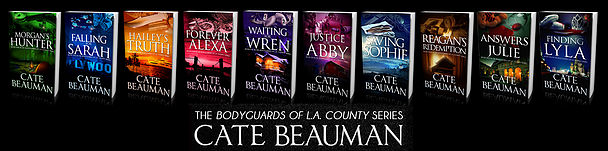
BODY GUARDS OF L.A.
#10
FINDING LYLA
By
Cate Beauman


SYNOPSIS
Principal Dancer Lyla Markovik-Avery is always on the go. Grueling practices and endless performances rule her busy days—and things are about to get more hectic. Russia is rolling out the red carpet for their beloved star, despite the string of violent terrorist attacks that have rocked the nation.
Bodyguard Collin Michaels’ life is falling apart. His long-time relationship recently ended. He’s trying to start over, but that’s easier said than done. Luckily, Collin has a new assignment on the horizon: keeping a beautiful ballerina safe for the next three weeks.
Collin finds comfort in Lyla’s easy friendship, but that all changes after a night out on the town. Simple feelings become complicated—something Collin can’t afford, especially when tragedy strikes and Collin realizes Lyla’s caught in the middle of a dangerous plot for revenge.
Collin and Lyla are forced to flee. They need to reach the border before it’s too late, but the odds are stacked against them in a country that wants them dead. With time running out, Collin formulates a risky plan that might be their only chance of making it out alive.

REVIEW
Cate Beauman has re-invented the fairy-tale.  She has taken it out of the realm of “Once upon a time” and brought it into the here and now and made it believable.  The knight in shining armor isn’t limited to the shelves and tomes of literature, the damsels in distress can be saved and swept off their feet and rescued to be loved and live happily ever-after, with their prince charming.
Finding Lyla is all about discovering that there really are princesses who hurt and who need to be rescued and loved very much.  It is about knights in shining armor whose armor is a bit scuffy and bent and worn, who suddenly discover that they just might truly be Prince Charming.  But in the midst of all this they fall in love with the very princess they are sworn to save from the fiery dragon and the black knights who swear vengeance on the realm.
But I love that the princess is actually a ballerina, daughter of a Russian prima ballerina, who has risen in the ranks on her own rights.  A young lady who loves others and has such a sweet young heart and thinks of others before herself, while her father serves his country a long way off,… in a cold, cold land.  Sound just like a fairy-tale, or a ballet.
My children, both female and male, grew up on the boards from the time they were three years old.  They studied under wonderful masters for years, some for about 6 years, and others for almost 20 years.  I worked behind the scenes many years helping to make the shows work, from helping with the young charges, to costuming and creating some of the wonderful creations that floated across the stage.  Ballet is a fantastic world of wonder that is a mesh of storytelling, music, dance, movement, and athleticism.  There are the artists, the prima-donnas, and the hard-working craftsmen who come together to  create a world of wonder that will mesmerize an audience for hours as they move and dance to the masterful music of the masters.  One of the masters once told my daughter that the true dancer was one who was one with the music.  When looking for the truly gifted, they watched to see how the dancer moved in the breaths of the music, for that told them that they were one with the music and not counting the steps.
Maybe it was because of this long history with the arts and with music and dance, but I found myself once again living backstage, sitting on the hard benches along the walls of the practice rooms, and breathing the music and movement of the dance again.  No, I don’t dance, never could, never will.  Lol.  But music runs deep in the well of my soul and I believe I have the heart and soul of a dancer.  If my feet could leave the earth, they would fly across the boards and though the wind, just as effortlessly as the most beautiful of the ballerinas I watch from the sidelines.
Cate was able to catch this same passion and essence of dance on the pages of Finding Lyla.  You find yourself flying across the pages and feel yourself floating through the air like you have always dreamed a dancer would feel, feeling the shear pain of injury as you land.  The agony of pain piercing up through your body as you force yourself to continue powering through, while you feel blood flowing down your toes.  Then feeling the agony of pain as you, out of pride, refuse to limp away at the end of the dance.  Been there, watched it as they hobbled off the stage and met them to attend to their needs.
I love this story, this modern day fairy-tale.  I love falling in love again, and again.  What a wonder way to curl my toes and escape for a long weekend read.  Cate does not disappoint!   I give this, her 10th book in the series a fantastic FIVE STAR rating for her story-telling abilities and the story craft she used to get the story across to us at a new level of AHHHhhhhhh.

ABOUT THE AUTHOR International bestselling author Cate Beauman is known for her full-length, action-packed romantic suspense series, The Bodyguards of L.A. County. Her novels have been nominated for the National Excellence in Romance Fiction Award, National Indie Excellence Award, Golden Quill Award, Writers Touch Award, and have been named Readers Favorite Five Star books. In 2015, JUSTICE FOR ABBY was selected as the Readers' Favorite International Book Award Gold Medalist, while SAVING SOPHIE took the Silver Medal. SAVING SOPHIE was also selected as the 2015 Readers Crown Award winner for Romantic Suspense and FALLING FOR SARAH received the silver medal for the 2014 Readers' Favorite Awards.   Cate makes her home in North Carolina with her husband, two boys, and their St. Bernards, Bear and Jack. Currently Cate is working on Deceiving Bella, the eleventh novel in her popular Bodyguards series.   SIGN UP FOR CATE’S NEWSLETTER TO BE NOTIFIED OF MONTHLY GIVEAWAY OFFERS http://www.catebeauman.com/#!newsletter-sign-up/c9td Contact Cate Website I Facebook I Twitter I Goodreads I Amazon Author Page image007 a Rafflecopter giveaway                              
 

A Desperate Fortune by Susanna Kearsley - A Book Review

A DESPERATE FORTUNE
By
Susanna Kearsley

SYLLABUS:
For nearly 300 years, the mysterious journal of Jacobite exile Mary Dundas has lain unread — its secrets safe from prying eyes. Now, amateur codebreaker Sara Thomas has been hired by a once-famous historian to crack the journal's cipher. But when she arrives in Paris, Sara finds herself besieged by complications from all sides: the journal's reclusive owner, her charming Parisian neighbor, and Mary, whose journal doesn't hold the secrets Sara expects.

It turns out that Mary Dundas wasn’t keeping a record of everyday life, but a first-hand account of her part in a dangerous intrigue. In the first wintry months of 1732, with a scandal gaining steam in London, driving many into bankruptcy and ruin, the man accused of being at its center is concealed among the Jacobites in Paris, with Mary posing as his sister to aid his disguise.

When their location is betrayed, they’re forced to put a desperate plan in action, heading south along the road to Rome, protected by the enigmatic Highlander Hugh MacPherson.

As Mary's tale grows more and more dire, Sara, too, must carefully choose which turning to take... to find the road that will lead her safely home


REVIEW
I love when I come across a novelist who is capable of giving the reader a book that makes them think, that makes them interact with the characters of the book and become involved with the multiple storylines they weave through the pages and chapters of their work. 
A Desperate Fortune did just that.  This work gave the reader a very delicate social and medical plot for the protagonist in the current age that she had to deal with.  Susanna enabled us to live with Aspergers and see the world through the eyes of Sarah.  She did a fantastic job of it.  At the same time, she wove a very gentle love interest plot through as a subplot, but it wasn’t just a romantic love interest, it was about learning to love.  It was beautiful and I found myself also falling in love with both gentlemen of the house, very deeply in love.
The second major plot and storyline took us to another time and place 300 years earlier.  This story and the ebb and flow of the characters were of a totally different feel.  It was almost as if it was two different books.  But this was not a bad thing.  The characters were totally different.  The times and the demands of what was happening within the diary that Sarah was translating dictated what the second storyline followed. 
I loved that Susanna did not leave us, the readers to the strict diary renderings as to what we discovered about what happened 300 years prior, but allowed us to see the world through the eyes of the young lady, Mary, who wrote the diary.  In doing so, we were able to better glimpse the strife and restrictions that living in the court of King James court in France and Rome. 
The time that Susanna took to develop the central characters in both settings brought the stories alive.  From the poignancy of the life of Sarah in modern France as she grew more self-assured and slowly fell in love to the wild and scary times of the 1700s in France, Spain, and Italy as Mary, the 1700’s protagonist discovered her strengths and self-reliance those many years ago in another place and time. 
With each turn of the page, I found myself wanting more and more from the characters and the story itself.  Susanna stepped up to the plate and delivered.  Each time she stepped from one time period to the other, I found myself devastated, I was so immersed into the story and characters of the period I was living and breathing.  I did not want to leave.  It was the same with the next time swap, I did not want to go back.  But as soon as the story picked up, I knew new information would come up, and it did that pulled me right into the timeline of the new time period I was in, along with the storyline that was swirling around the characters that were moving swiftly through the pages. 
This is not my first Susanna Kearsley book, nor will it be my last.  Each of her novels are unique and touch heart strings at their deepest levels.  This novel has earned my highest praises and will be one that I pull out to read and enjoy again.  I would give A Desparate Fortune a Five Star review for the telling of the story and for the story craft in the telling.

ABOUT THE AUTHOR
Susanna Kearsley Aka Emma Cole.

Susanna Kearsley studied politics and international development at university, and has worked as a museum curator.

Her first novel Mariana won the prestigious Catherine Cookson Literary Prize and launched her writing career. Susanna continued her mix of the historical and paranormal in novels The Splendour Falls, Named of the Dragon, Shadowy Horses and Season of Storms.

Susanna Kearsley also writes classic-style thrillers under the name of 
Emma Cole.
Contact the author at http://www.susannakearsley.com/ 
Where to buy A Desparate Fortune